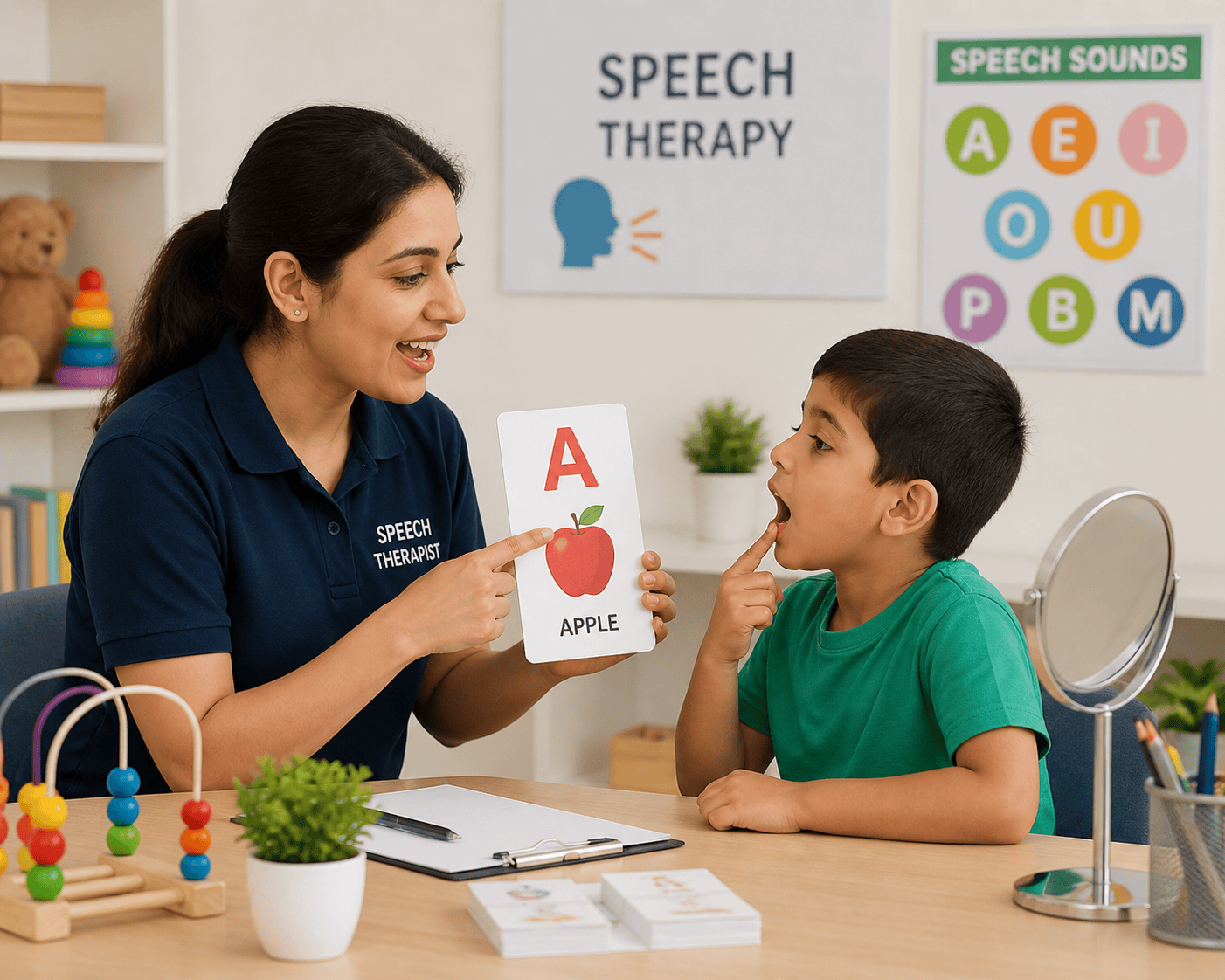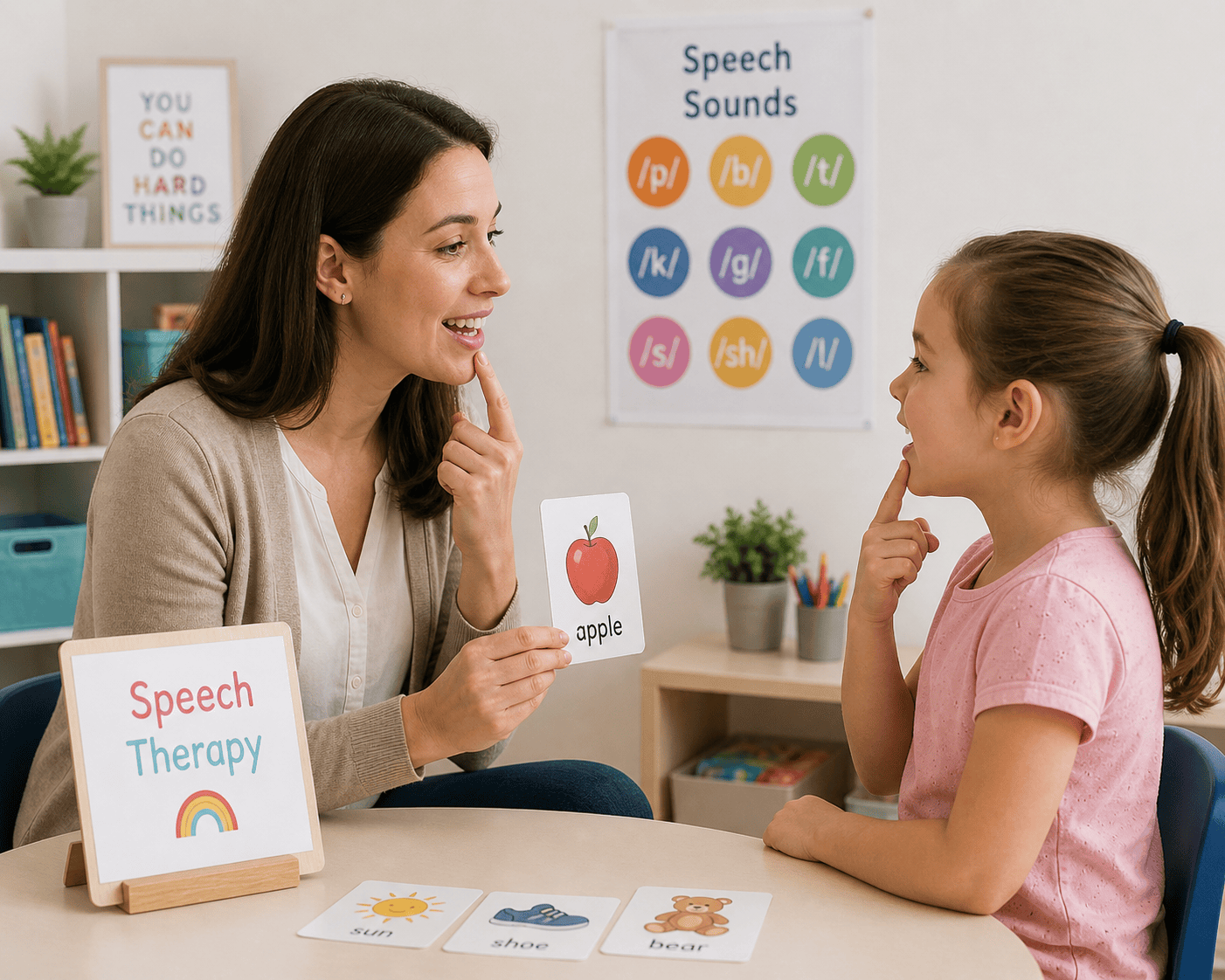


Looking for "speech therapy for autism in Lucknow" or an "autism communication specialist near me"? You've come to the right place. Autism Spectrum Disorder affects 1 in 36 children globally — and communication is at the heart of the autism experience. Speech therapy is not optional for autistic children — it is essential. This guide explains exactly what autism speech therapy does, how it works, and what families in Lucknow can expect from the journey.
Understanding Autism & Communication
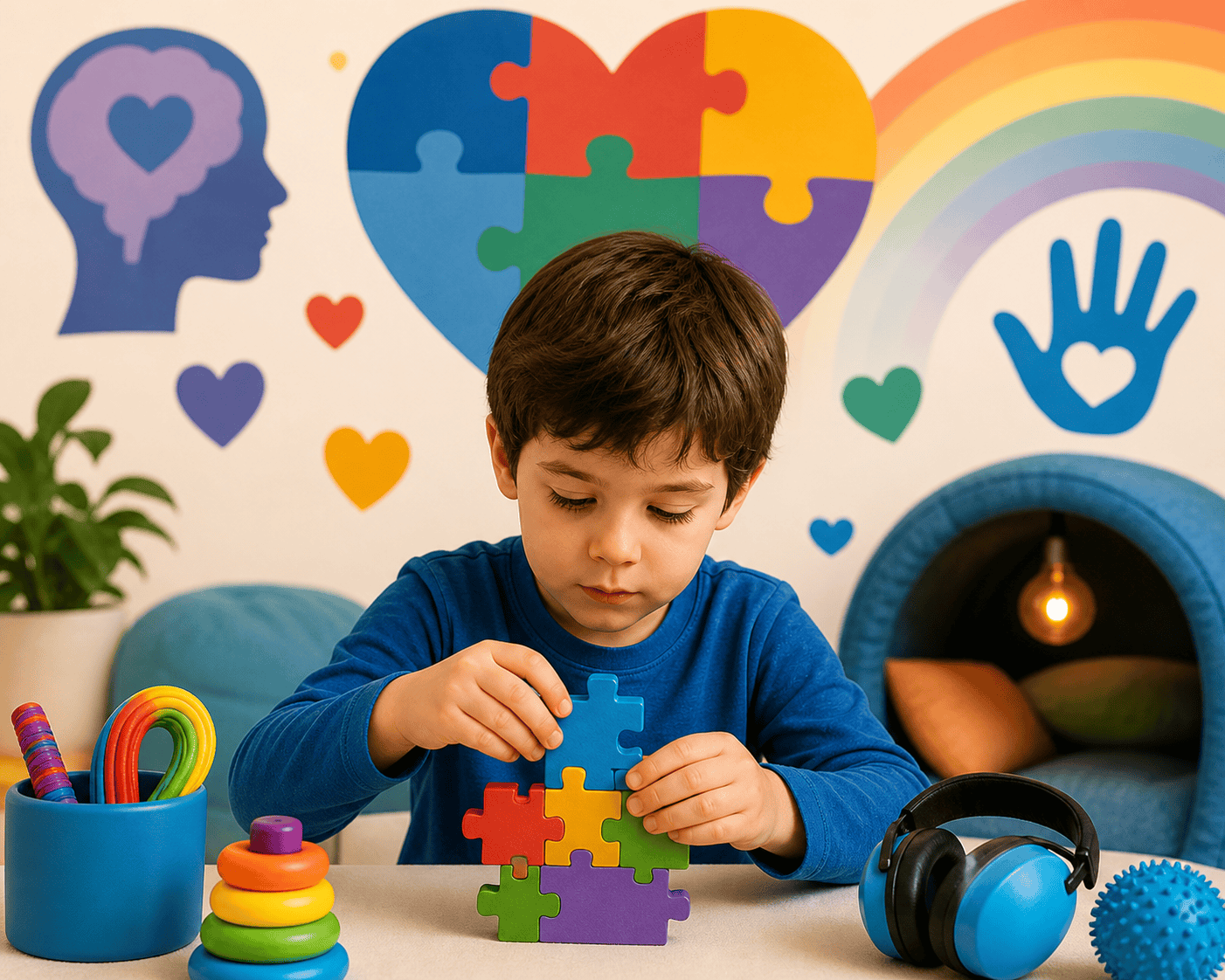
Autism Spectrum Disorder is a neurodevelopmental condition characterised by differences in social communication, social interaction, and the presence of restricted or repetitive behaviours. The word "spectrum" is important — autism looks profoundly different from one child to the next. A non-verbal four-year-old and a highly articulate teenager who struggles with conversation are both autistic.
Autism speech therapy in Lucknow builds:
- Joint attention and communication intent
- Vocabulary, sentences, and conversation skills
- Social-pragmatic language for peer interaction
- AAC and PECS systems for non-verbal children
- Confidence in school and community settings
Communication Challenges in Autism
Understanding the specific ways autism affects communication helps parents in Lucknow recognise what their child is experiencing — and why specialist therapy is so different from standard speech treatment:
Many autistic children are late to say their first words or may not develop spoken language at all. Some speak only in single words or short phrases well past the typical developmental window.
Repeating words, phrases, or full sentences heard from others or TV — either immediately or hours later. While often misunderstood, echolalia is actually a functional communication strategy that therapy can build upon.
Difficulty following another person's gaze, pointing, or sharing focus on an object or event. Joint attention is the foundation of all language learning and social communication.
Autistic children often interpret language literally — idioms, sarcasm, and figures of speech like "it's raining cats and dogs" may cause genuine confusion or distress.
Understanding the unspoken rules of conversation — taking turns, reading facial expressions, staying on topic — is frequently challenging and requires explicit, structured teaching.
Many autistic children speak in a flat, monotone voice, very loudly, or with unusual rhythm. These prosodic differences affect how their communication is received by peers and adults.
Early Signs of Autism to Watch For
These red flags should prompt an immediate assessment — at any age. In Lucknow, diagnostic waiting lists can be long. Do not wait for a diagnosis — our therapists can begin evidence-based intervention as soon as red flags appear:
Why Lucknow Families Trust Growing Stars for Autism
All therapists are RCI-registered and specifically trained in PECS, AAC, and autism communication interventions.
Centrally located in Aliganj, Lucknow with in-clinic, home-visit, and online session options.
Trusted by 120+ families across Aliganj, Indira Nagar, Gomti Nagar, and Vikas Nagar.
Therapy Approaches for Autism in Lucknow
Our autism speech therapists in Lucknow begin with a thorough individual assessment and select approaches based on the child's age, severity, and communication profile. Every plan is personalised — no one-size-fits-all approach.
Building intentional communication from picture exchange to speech-generating devices and apps.
Structured teaching of conversation, turn-taking, emotion reading, and peer interaction skills.
Every plan includes parent training so therapy extends into every waking hour at home.
PECS — Picture Exchange Communication System
For Non-Verbal ChildrenPECS teaches children to communicate by exchanging picture cards for desired items or activities. It builds the concept of intentional communication from the ground up and often serves as a bridge to spoken language.
AAC — Augmentative & Alternative Communication
Speech-Generating DevicesAAC includes everything from low-tech communication boards to high-tech speech-generating devices and apps like Proloquo2Go. AAC does not replace speech — research consistently shows it supports spoken language development.
PROMPT Therapy
Motor-Based ApproachPROMPT uses tactile-kinesthetic cues — the therapist physically guides jaw, lip, and tongue movements — to help children produce sounds they cannot generate independently.
Social Communication Intervention
Pragmatic LanguageStructured teaching of conversation rules: greetings, turn-taking, topic maintenance, reading emotions, and understanding perspective. Uses role-play, video modelling, and real-world practice in Lucknow settings.
DIR / Floortime
Relationship-BasedDeveloped by Dr. Stanley Greenspan, Floortime follows the child's lead through play to build emotional connection, shared attention, and spontaneous communication in a natural, joyful environment.
Naturalistic Developmental Behavioural Interventions (NDBIs)
Evidence-BasedBlending ABA principles with naturalistic developmental approaches, NDBIs such as JASPER and ESDM embed language targets into everyday play and routines — dramatically increasing generalisation of skills.
Therapy Goals: Phase by Phase
A phased roadmap for what autism speech therapy looks like over the first 12–18 months at our Lucknow clinic:
- →Establish communication intent — the child learns that communicating gets results
- →Build joint attention through structured play routines
- →Introduce PECS or AAC if verbal speech is absent or limited
- →Train parents in low-demand, high-response interaction styles
- →Expand vocabulary: nouns, verbs, descriptors in meaningful contexts
- →Develop two- and three-word combinations
- →Introduce turn-taking in structured and semi-structured play
- →Begin addressing echolalia as functional communication
- →Conversation skills: greetings, asking questions, making comments
- →Emotion recognition and perspective-taking exercises
- →Narrative language — telling stories, describing events
- →School and peer-context language for Lucknow classroom settings
- →Transfer skills to home, school, and community environments
- →Reduce prompt dependency — moving toward independent communication
- →Family and teacher coaching for consistent strategies across settings
- →Periodic review and goal updates as the child grows
The Role of Parents at Home
Research is unambiguous: parent involvement is the single greatest predictor of outcomes in autism speech therapy. One hour of therapy per week is powerful — but it is the 167 other hours that determine how much your child grows. Here is what the evidence says works:
Follow the 3-second rule
After asking a question or making a comment, wait silently for 3 full seconds before speaking again. Autistic children often need more processing time than neurotypical peers.
Use their interests as a bridge
If your child loves trains, use trains in every activity — counting carriages, labelling colours, creating train stories. Motivation is the most powerful teacher.
Create a visual schedule
Pair pictures or photos with daily routines (breakfast → school → therapy → dinner → bath → bed). Predictability reduces anxiety and increases communication opportunities.
Expand, don't correct
When your child says "ball", say "red ball" or "throw ball" — expand their utterance naturally rather than asking them to repeat it correctly. This models without pressure.
Embed language in play every day
Spend at least 20 minutes daily in child-led play with zero demands. Simply narrate, comment, and play alongside. This is the single most evidence-supported thing parents can do at home.
Use video modelling
Short videos of desired social skills — greetings, asking to play, handling frustration — are highly effective for autistic learners. Record your child's own skills to watch and reinforce.
Why Early Intervention Changes Everything
The brain is most plastic and receptive to language learning in the first 5 years of life. Every month of delay in starting therapy is a month of missed neurological opportunity. If you are a parent in Lucknow noticing signs of autism — act now, not after the diagnosis.
Our team has helped over 300 children across Lucknow — including many who were non-verbal at referral — achieve meaningful, functional communication through structured early intervention programmes.